ADDIS ABABA – I spent this afternoon in the Plenary Hall of the African Union, watching Obama’s Ghana speech and listening to the responses it drew from some hundred of the AU and local embassy staff in attendance.
The broadcast quality was bad from the Ghanaian end due to the rains, and we all strained to hear. It was perhaps for that reason that the response during the speech was muted in comparison to the discussion afterwards. The line (I’m para-phrasing) that Africa doesn’t need strong men it needs strong institutions got the kind of applause you would expect when sitting inside Africa’s foremost institution. And the acknowledgment that for far too many Africans conflict is a part of life, “as constant as the sun”, merited an all round “ah-hmm” of affirmation. But the real reactions came in the Q & A that followed the panel discussion organized by the US Mission to the AU.
Professor Johnson, Adviser to the AU Commission Chairperson, said that what he heard was there would be an end to the current aid policy. “What it means is that the policy of begging hands must stop and any future policy must be based on partnership. This is important for all our states.” Panelist, Dr Murithi rebutted this interpretation, saying that he didn’t hear a call for the elimination of aid, but rather for “more responsible development assistance.” But, he continued, “the hot issue not on the table was the US subsidies to agricultural industries . . . but we know the power of special interest groups in Washington.” Another panelist subsequently contuned with this theme saying while Africans know there are constituencies in the US pushing for the maintainence of agricultural subsidies, this should not be the end of the conversation – “there is a constituency here too” she said.
A representative of the Kenyan Embassy (referring to himself as being “from Obama’s true country” to peels of laughter and clapping) was disappointed that the speech wasn’t more of a “shake-up of US-Africa policy.” Perhaps indicative of the snub many Kenyans are feeling at not having Obama come to the country of his father first, he speculated that the reason Ghana was chosen as the site of Obama’s first sub-Saharan Africa speech was the oil prospects there. This view was quickly challenged by others who maintained that it was Ghana’s democratic system that drove the choice, with others claiming Ghana was selected as “the birthplace of pan-Africanism.” One of the panelists commented that it was the technique of the speech to use Ghana as an example of the positive face of Africa: “More than half the speech would have to have been cut if he was doing it from – well, I don’t want to make enemies, but basically name any other country” he said.
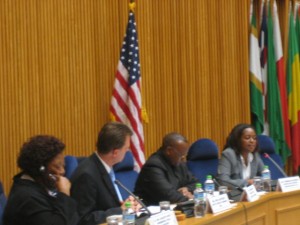
Everyone who spoke came from a baseline position that was clearly positively disposed towards Obama. But that didn’t stop there being some heartfelt criticism. As one of the AU Commission staffers put it, “Coming from a person we completely respect and admire, it was worrying to see the whitewashing of our past. The role of the West in our difficulties must be understood. That doesn’t mean we will just sit back and blame them, but we must understand the legacy it has had.” Reacting to Obama’s line that the West was not responsible for the destruction of Zimbabwe’s economy, he said “We may not agree with the strategic choices of Zimbabwe’s government of late, but the history of the country must be recognized, not just wished away.” And as panelist Dr Murithi expressed it, “there were some silences and omissions . . . The Cold War role of the US in Africa must be acknowledged before we can proceed with a new partnership.” However one of the AU’s senior specialists on conflict prevention took a different approach, arguing that “the deepest of Africa’s wounds are self-inflicted.”
One of the panelists was the AU Commissioner for Trade and Industry, who said that a new partnership must involve the US putting funds into developing oil refineries in Africa, so they didn’t have to export crude oil to others, only have to buy refined oil back for the local population. “This would be an even more effective way of tackling poverty than humanitarian aid” she concluded.
A staffer at Peace and Security noted that while it was all very well to complain about the arming of children, “the US and Africa must sit down to address the scourge of the inflow of arms or else Africa will continue to be in conflict for the next century.” He also argued that the best thing the US could do was to help the AU stand against external interference from former colonial powers.
The youngest member of the panel, Kebede Yemisrach, who works on citizenship and participation issues, said that Obama “personifies hope for us. Africans needed him to speak to us today.” But she added that, perhaps because he was talking in front of an audience of parliamentarians with a good track record, he restrained himself on some of the problems. With a different audience, she speculated, “he could have spoken more straight.” The head of Economic Policy at the AU began his intervention by saying that the speech “leaves much to be desired”, pointing out that Africa has had to deal with successive crises and that there were no concrete answers given on how to cope with this. The way forward, he argued, was to break down barriers between countries and regions in Africa so they can build better trade relationships with each other. This sentiment was taken a step further by another intervention arguing that “the US must continue to help the AU be a strong institution, leading to the final dream of all Africans – a United States of Africa.”
The final word of the afternoon went to the Deputy AU Commissioner, who commented that if friends are seeking to extend their friendship it must be based on mutual needs, then asking, without indicating his own view: Did you perceive in the speech that the U.S. needs Africa – or is it only Africa that needs the U.S.?